Who can precept a Spring Arbor student, track by track
For SAU's NP practicums the preceptor is a certified nurse practitioner, physician or physician assistant who practices near you and passes faculty review. For NUR 780B, taken by Nurse Educator and MSN/MBA students, SAU's pages add a fourth option: a master's-prepared nurse in a specialty field. Much else, from years of experience to employer rules, SAU does not publish.
Get your placement plan
Tell us your Spring Arbor track and where you live. A placement advisor replies with what your preceptor and site need to look like for Spring Arbor to approve them.
01The rule for NP practicums
In the 2023-24 Graduate Catalog, an NP student's practicum runs under a local preceptor who is "either a certified NP, physician, or PA," once program faculty sign off, and SAU clinical faculty keep watch over it. Search-engine snippets of later catalog course pages show the same arranged-with-a-local-preceptor wording, though those pages could not be opened.
Two words carry weight. SAU does not define "certified," but for a nurse practitioner it most naturally means national board certification on top of a license, so expect faculty to ask about both. "Local" ties the preceptor to where you live, in step with SAU's FAQ telling you to choose a preceptor in your home state.
Older SAU pages were narrower. In 2015 and 2022 the site accepted only a certified NP or a physician in a primary care setting and said nothing about physician assistants. If a classmate quotes that older rule, the catalog wording is the more recent source.
02Track by track
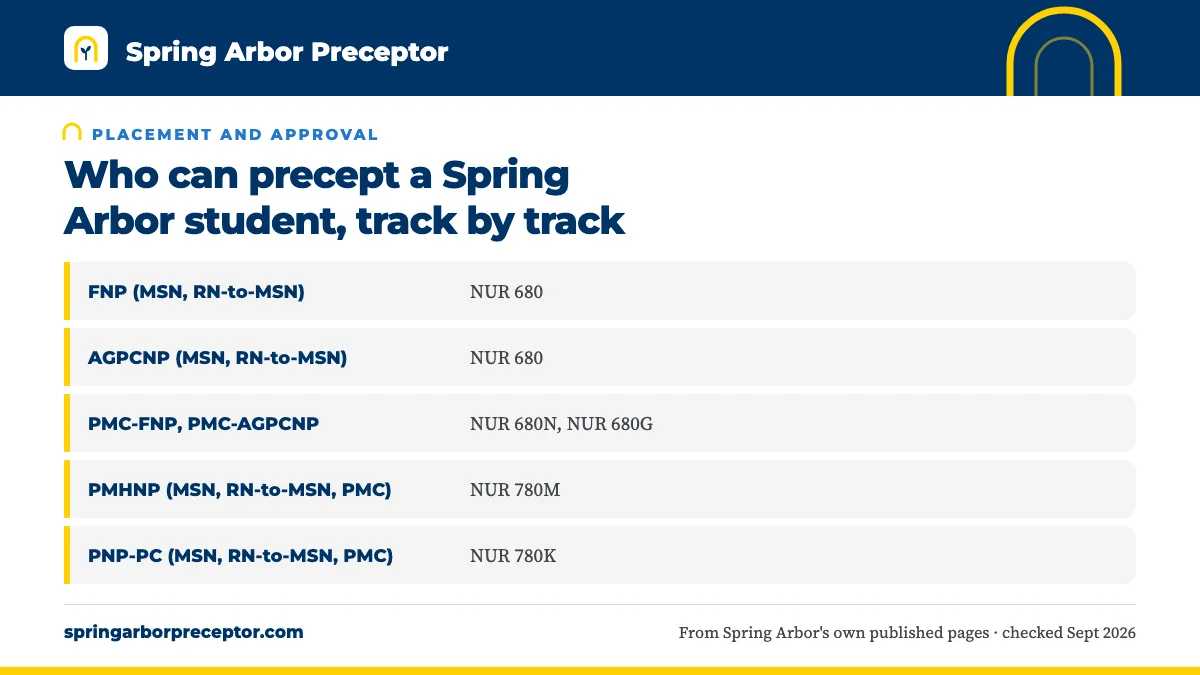
Course numbers come from the 2023-24 catalog except NUR 780B, which appears on SAU's current program pages; ask your advisor if any have been renumbered for your cohort. Hour totals for each track are on clinical hours.
| Track | Clinical course | Who may precept | Notes |
|---|---|---|---|
| FNP (MSN, RN-to-MSN) | NUR 680 | Certified NP, physician or PA | Primary care; coursework spans adults, older adults, childbearing families and children |
| AGPCNP (MSN, RN-to-MSN) | NUR 680 | Certified NP, physician or PA | Adult and late-teenage patients in primary care |
| PMC-FNP, PMC-AGPCNP | NUR 680N, NUR 680G | The same NP practicum model | PMC-FNP hours depend on prior certification |
| PMHNP (MSN, RN-to-MSN, PMC) | NUR 780M | The NP practicum model; confirm psychiatric expectations with faculty | Psychiatric-mental health across the lifespan; plan on several placements |
| PNP-PC (MSN, RN-to-MSN, PMC) | NUR 780K | Preceptors within pediatric NP scope of practice | Infants, children and adolescents in pediatric primary care |
| Nurse Educator, MSN/MBA | NUR 780B | Certified NP, physician, PA, or a master's-prepared nurse in a specialty field | Hours in a direct-care setting |
| Nurse Educator internship | NUR 660 | Not stated | Individually supervised field experience in nursing education settings |
| DNP | NUR 880 | Not stated | Described as a faculty-led clinical immersion |
03What faculty approval adds to the credential
Meeting the credential rule gets a preceptor considered, not accepted. Faculty approve the preceptor and site for every rotation, so a clinician cleared for one semester is looked at again for the next, and a second site brings its own review. The process is on preceptor approval. Approval also rests on your side of the file: prerequisites passed and compliance records current.
Fit with the course matters as much as the letters after a name. A PNP-PC student needs a preceptor practicing within pediatric NP scope; a PMHNP student needs psychiatric-mental health patients; an FNP student's coursework runs from adults and older adults to childbearing families and children. SAU publishes no quotas for any of these, but a preceptor whose patient mix can't support your course objectives makes a weak proposal.
04Settings SAU mentions
SAU's clinicals FAQ post lists the kinds of places students train: family practice, internal medicine, pediatrics, urgent care, hospitals and community health clinics. It reads as a list of possibilities, not a menu with rules attached.
Match the setting to the track before you ask anyone. Internal medicine may suit adult-focused primary care hours, and pediatrics serves PNP-PC students and the child-focused part of FNP work. Whether a hospital-based rotation fits a primary care track is a question for your faculty, and it is better asked before the clinician has agreed than after.
For NUR 780B, SAU's current pages specify hours in a direct-care setting, and they describe the extra preceptor option as a master's-prepared nurse in a specialty field. Ask faculty how they read "specialty field" for your plans before you approach anyone. The education-setting hours in NUR 660 are a separate matter, covered on the Nurse Educator internship page.
05What SAU does not publish
Several of the questions students ask most are not answered anywhere SAU publishes. Treat each as a question for your program, and get the reply in writing.
- A minimum number of years in practice for a preceptor.
- Which state the preceptor must hold a license in.
- Any required share of physician or PA preceptors versus NPs.
- Whether your workplace, or your own unit inside it, can host you; see training where you work.
- Whether a relative may precept you.
- Whether preceptors may be paid, or charge a fee.
- Any limit on telehealth hours.
Silence is not permission. A preceptor arrangement that seems fine because no rule forbids it can still be declined at review, and a late refusal costs more than an early question. For telehealth specifically, virtual clinical options sets out what to ask.
06Checking a preceptor before the paperwork
A little checking up front saves a rejected packet. Confirm the clinician's license is active and unrestricted on the state board's public lookup, and that an NP's board certification is current and matches the population you need. Note the practice's legal name and address, since the site is reviewed along with the person.
Then confirm the fit with your course: which patients the practice sees, how busy the schedule runs, and whether the preceptor can give you the hours your course needs that term. SAU's catalog ties each clinical hour to actual patient contact, roughly one patient per hour, so a thin schedule means slow progress. Preceptor outreach covers how to make the request.
When our placement desk brings you a name, it has been screened against these same published rules. The decision still belongs to SAU's faculty, and our screen means the name reaches them already fitting what they check.
Questions Spring Arbor students ask
Can a physician assistant precept an SAU nurse practitioner student?
Yes, under the 2023-24 catalog's NP practicum wording, which names a certified NP, physician or PA. Older SAU pages from 2015 and 2022 listed only NPs and physicians, so you may still hear otherwise. Faculty approve each preceptor, so confirm a PA's fit for your particular course with your program.
Can a nurse with a master's degree be my SAU preceptor?
For NUR 780B, yes. SAU's current Nurse Educator and MSN/MBA pages list a master's-prepared nurse in a specialty field as an option next to NPs, physicians and PAs. For the NP practicums, SAU's wording names only certified NPs, physicians and PAs, so a master's-prepared RN would not fit that rule.
How many years of experience does an SAU preceptor need?
SAU does not publish a minimum. The published requirements are the credential, being local, and faculty approval. Faculty may still weigh experience when they review a preceptor, so if yours is newly certified, say so up front and ask your program whether it affects approval.
Must an SAU preceptor be licensed in my home state?
SAU does not say so directly. Its FAQ points you to a preceptor in your home state, and the 2023-24 catalog requires your own RN license in the state of practice, so usually both licenses sit in the same state. If a site crosses a state line, read RN license for clinicals and ask your program first.
Can a family member precept me at Spring Arbor?
SAU publishes no rule either way. Faculty approve every preceptor, and they may see a family tie as a conflict of interest even without a written policy. Ask your program before you approach a relative, and keep a second option in play while you wait for the answer.
Related pages
Last checked 2026-09-24
We check these pages against Spring Arbor's own published sources. SAU's nursing faculty and current catalog have the final word.
More preceptor leads, sooner, for your SAU clinicals.
Tell us your Spring Arbor track, where you live and when your clinical course starts. We look for a preceptor and site that fit SAU's rules for your track and help you get the paperwork in on time.
- Matched to your track: FNP, AGPCNP, PMHNP, PNP, Nurse Educator or DNP
- Clinical agreement, affiliation and preceptor verification forms ready early
- In your home state, near where you live
Start your placement plan
A placement advisor replies with what an SAU-ready preceptor and site look like for you.