Spring Arbor PNP-PC: 500 hours in pediatric primary care
Spring Arbor's online Pediatric Nurse Practitioner, Primary Care track requires 500 clinical hours with infants, children and adolescents, run in the 2023-24 catalog as two semesters of NUR 780K. You propose preceptors who work within pediatric NP scope, and faculty approve each one. The PNP page carries no partner-network promise, so the search is yours to start early.
Find a pediatric preceptor
Tell us your NUR 780K term and your area, and a placement advisor will look for pediatric primary care practices near you.
01What the PNP-PC page and the catalog say
SAU's PNP-PC page puts the track at 50 credits and 500 clinical hours over roughly two years and five months, with a single four-day residency on campus in the second year. The page features NUR 702 Advanced Pediatric Physical Assessment and Pharmacotherapeutics, NUR 703 on primary care of infants, children, adolescents and their families, and NUR 781 on integrating evidence.
The 2023-24 Graduate Catalog builds the concentration from NUR 702 through NUR 705, then NUR 780K, the PNP Clinical Practicum, at 4 credits in each of two semesters, then NUR 781. Its footnote sets at least 500 supervised hours in the practicum. Two other figures float around, and the table shows where each comes from.
| Source | Date | Hours |
|---|---|---|
| PNP-PC program page and tuition page | 2026, live | 500 |
| 2023-24 Graduate Catalog | 2023 | at least 500 |
| SAU clinicals blog post | first seen 2021 | 530 |
| Third-party NP school directory | undated | 570 |
SAU's live pages are the newest source, so plan on 500 and confirm against your syllabus.
02NUR 780K: the patients and the scope
In the 2023-24 catalog, NUR 780K covers infants, children and adolescents in the context of their families. The description names well-child care, acute illness, and complex chronic or disabling conditions. That spread is the useful checklist when you size up a practice: a clinic that sees only sick visits, or only teenagers, will leave parts of it thin.
Once a preceptor is approved, SAU's clinicals post says program faculty send them the planned progression and the objectives for each rotation. That helps a busy pediatric office see early on which visit types you need, rather than discovering gaps late in the second semester.
The course's listed prerequisite is NUR 702, the pediatric assessment and pharmacotherapeutics course. Because the catalog is from 2023-24 and the newer ones sit behind a human check, confirm the current course number and sequence in Brightspace or with your advisor. The NUR 780K practicum page covers the course in more depth.
03Preceptors within pediatric NP scope
The catalog says PNP students work with clinical preceptors within the pediatric nurse practitioner scope of practice, in pediatric primary care. SAU's general practicum rule adds the usual conditions: the preceptor is a certified NP, physician or PA, practices near you, and wins program faculty approval. Put together, the obvious fits are pediatric NPs, pediatricians and PAs working in pediatric primary care.
An FNP or family physician with a large pediatric panel may also qualify, but scope is the test, so let faculty judge it before you commit. Hospital-only pediatric settings are worth checking too, because the rotation is framed around primary care. SAU publishes no minimum years of practice and no rule on precepting at your own employer; the preceptor requirements page lists what else is left unsaid.
04Prerequisites and the residency
Every MSN practicum in the 2023-24 catalog waits on four passes: pathophysiology, pharmacology and health assessment at the advanced level (NUR 612, NUR 618, NUR 602) plus the NUR 602R residency. The PNP practicum adds NUR 702 on top. Current NP pages also mention NUR 628, pharmacology for nurse practitioners; whether it now sits in front of clinicals is unverified.
NUR 602R brings you to the main campus in Spring Arbor, Michigan for four days in year two, tied to health assessment, with a head-to-toe check-off. A delayed residency delays NUR 780K too. The MSN residency page covers what to expect, and the prerequisites page keeps the full order in one place.
Separately, the compliance file has to be current before your first pediatric clinical day: license, liability insurance, background check, drug test and health records. The clinical compliance page lists each item.
05No partner-network line for the PNP
In 2026 SAU added a line about working with students to secure placements, and access to a clinical partner network, to its FNP and PMHNP pages. The MSN PNP-PC, RN-to-PNP and certificate PNP pages do not carry it, as of September 24, 2026. For this track the FAQ's plain statement stands: you choose your own preceptor in your home state.
That does not leave you alone. SAU's published help includes asking the SAU Online program director for local providers who volunteered to host SAU students, checking which sites near you already have affiliation agreements with SAU, and a Student Success Coach who supports you through placement. Use all three before the practicum term is close, and see the find your own preceptor page for ways to widen the net.
06State limits and Washington
Alabama, Arizona, Louisiana and New York are the four states SAU names as lacking authorization for its nursing programs. Its March 2026 licensure disclosure names the FNP, AGNP and PMHNP as not meeting requirements in those four and does not mention the PNP at all, so a PNP student in or near those states should ask SAU and their board of nursing directly.
Washington residents can complete practice experiences at home: the state board's June 2026 list includes SAU's MSN PNP-PC for residents only, and SAU's accreditations page names the PNP-PC among programs approved there. SAU's list says nothing about DC or the territories. Your RN license must be unrestricted in the clinical state, and SAU's FAQ frames the search around your home state. More detail is on the state authorization page.
07Why SAU's PNP-PC students choose us
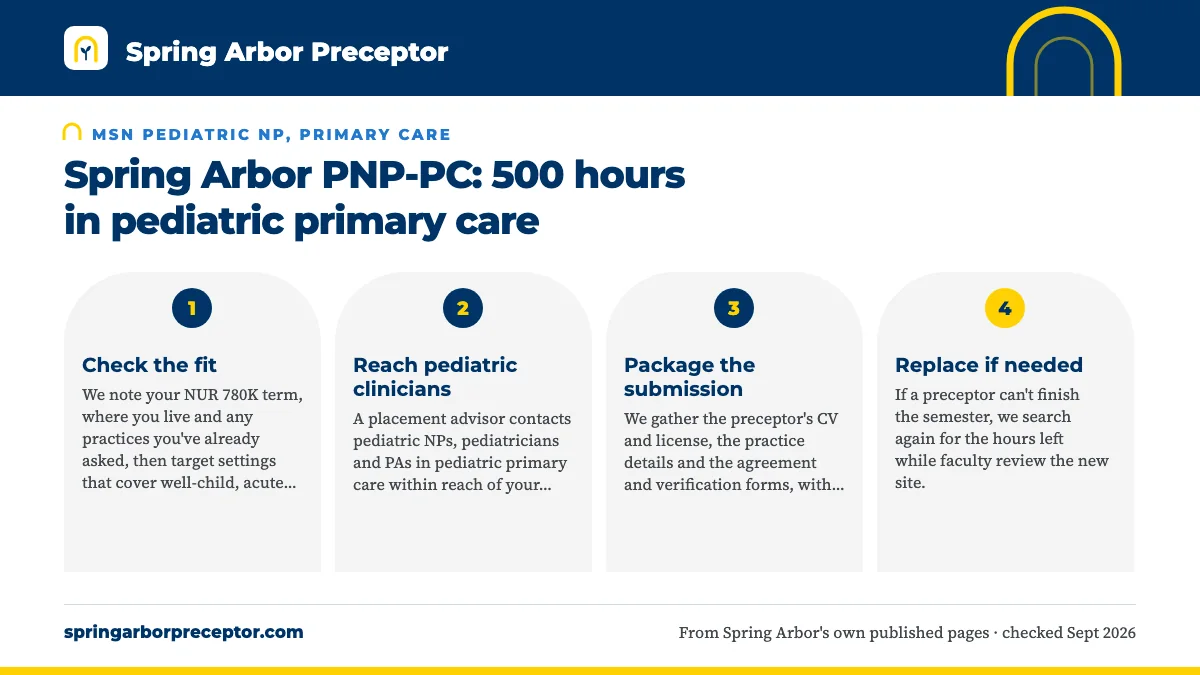
- Check the fitWe note your
NUR 780Kterm, where you live and any practices you've already asked, then target settings that cover well-child, acute and chronic pediatric visits. - Reach pediatric cliniciansA placement advisor contacts pediatric NPs, pediatricians and PAs in pediatric primary care within reach of your home.
- Package the submissionWe gather the preceptor's CV and license, the practice details and the agreement and verification forms, with a clear note on the pediatric patient mix.
- Replace if neededIf a preceptor can't finish the semester, we search again for the hours left while faculty review the new site.
Program faculty rule on each PNP-PC preceptor and site, and every pediatric lead we bring has already passed our screen. Compare hours across tracks on the clinical hours page, or send your details through the form below.
Questions Spring Arbor students ask
Is the Spring Arbor PNP 500 or 530 clinical hours?
SAU's program page and tuition page both give 500, matching the 2023-24 catalog. The 530 figure appears in an SAU blog post first seen in 2021, and a third-party directory lists 570. Go with 500 unless your course syllabus in Brightspace shows otherwise.
Can a family nurse practitioner precept my PNP-PC hours?
Possibly. The 2023-24 catalog asks for preceptors working within pediatric NP scope, in pediatric primary care. An FNP whose practice sees many children may meet that, but program faculty decide. Give them an honest picture of the pediatric caseload when you submit the preceptor.
Can a pediatrician be my PNP preceptor?
Yes. SAU's practicum wording allows a physician as well as a certified NP or PA, provided the preceptor is local and approved by program faculty. A pediatrician in primary care fits the scope described for NUR 780K, though faculty still review the site.
Do my PNP hours have to include infants and teenagers?
The 2023-24 course description covers infants, children and adolescents and names well-child care, acute illness and chronic conditions. SAU doesn't publish a required split by age. Ask faculty what spread they expect, and look for a practice that sees the full age range.
Does Spring Arbor's licensure disclosure cover the PNP?
The March 2026 summary covers the FNP, AGNP and PMHNP and leaves the PNP out. The state authorization list still excludes Alabama, Arizona, Louisiana and New York for all nursing programs, so check with SAU and your board of nursing before relying on a PNP in those states.
Related pages
Last checked 2026-09-24
We check these pages against Spring Arbor's own published sources. SAU's nursing faculty and current catalog have the final word.
More preceptor leads, sooner, for your SAU clinicals.
Tell us your Spring Arbor track, where you live and when your clinical course starts. We look for a preceptor and site that fit SAU's rules for your track and help you get the paperwork in on time.
- Matched to your track: FNP, AGPCNP, PMHNP, PNP, Nurse Educator or DNP
- Clinical agreement, affiliation and preceptor verification forms ready early
- In your home state, near where you live
Start your placement plan
A placement advisor replies with what an SAU-ready preceptor and site look like for you.