The RN license you need for SAU clinicals
SAU wants your RN license current, unrestricted, unencumbered and issued by the state where you practice. It also expects you to choose a preceptor in your home state. SAU's pages don't address multistate compact licenses or a clinical site across a state line, so settle those questions with your program before you sign a preceptor.
Get your placement plan
Tell us your Spring Arbor track and where you live. A placement advisor replies with what your preceptor and site need to look like for Spring Arbor to approve them.
01What SAU requires
The 2023-24 Graduate Catalog asks for a current, unrestricted, unencumbered RN license in the state or country of practice before any practicum. Its MSN admission section asks for a license from the state or country where you practice, kept current, and its DNP section adds an APRN license where one applies.
SAU's current web pages phrase it a little differently: an unrestricted, unencumbered, current nursing license from the state of employment. The online RN-to-BSN page asks for the same and says it must stay current throughout the program.
Read unrestricted and unencumbered as a license with no limits or conditions attached by a board of nursing. If yours carries any, talk to the program before you plan clinicals. The license is one item on a longer list; the rest is on our clinical compliance page.
02State of practice, state of employment and your clinical state
For many students the three are the same place. SAU's FAQ says you will choose your own preceptor in your home state, and the license you already hold for work is the one SAU sees at admission.
Trouble starts when they differ. You might live in one state, work in a second and find a willing preceptor across a third border. SAU doesn't say which state's license a clinical site in another state requires, and the catalog's phrase, state of practice, becomes ambiguous once you practice as a student somewhere new.
Settle it in writing before you sign anything. Ask your program which license it needs for a site in another state, and check that state's board of nursing. One graduate posted on a nursing forum in 2019 that a lack of SAU clinical faculty licensed in her state kept her from doing hours there. SAU publishes nothing on this, which is one more reason to ask first.
03Compact (multistate) licenses
SAU says nothing about the Nurse Licensure Compact. Under the compact, an RN who lives in a member state can hold one multistate license that the other member states honor. Whether SAU accepts a multistate license for a clinical site in another compact state is a question only your program can answer.
Not every state belongs. Michigan, SAU's home state, was outside the compact when we checked its records, with a bill pending. So were California, New York, Illinois, Minnesota, Oregon, Nevada, Hawaii and Alaska. Massachusetts passed compact legislation, but its nursing board aims to put it into effect in May 2027.
APRN licensure is separate. When we checked, five states had enacted the APRN Compact, and it does not take effect until seven have, so it offers NP students nothing yet. Look up your own state before relying on any of this, because membership changes.
04Where SAU's programs are authorized
A valid license in your state doesn't settle whether SAU can run clinicals there. Four states, Alabama, Arizona, Louisiana and New York, appear on SAU's state authorization page as lacking authorization for its nursing programs, and Washington practice experiences are open only to Washington residents in named programs.
SAU's March 2026 licensure disclosure also says its FNP, AGNP and PMHNP programs don't meet licensure requirements in those four states. The DNP page carries an older list that also excludes Mississippi.
The full picture, including the District of Columbia and the territories, is on our state authorization page. Each state also has its own page, listed under states.
05If you move during the program
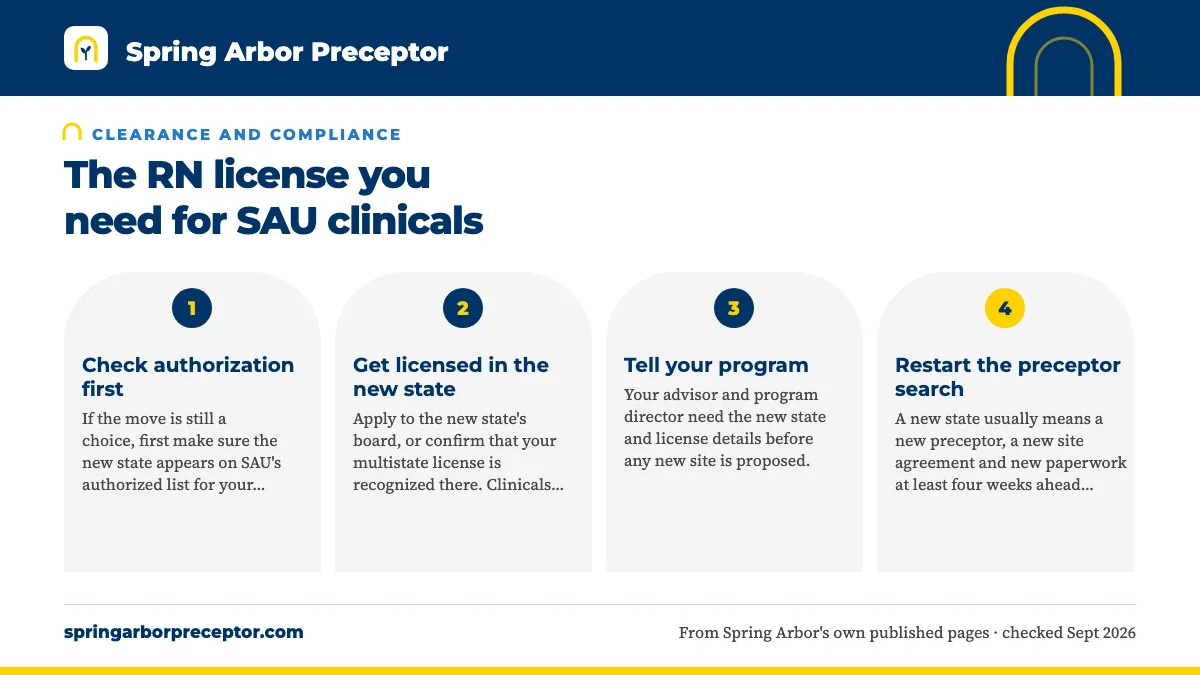
A move changes your state of practice, and with it your license, your authorization status and usually your preceptor. Take it in this order.
- Check authorization firstIf the move is still a choice, first make sure the new state appears on SAU's authorized list for your program.
- Get licensed in the new stateApply to the new state's board, or confirm that your multistate license is recognized there. Clinicals in the new state wait until the license is in place.
- Tell your programYour advisor and program director need the new state and license details before any new site is proposed.
- Restart the preceptor searchA new state usually means a new preceptor, a new site agreement and new paperwork at least four weeks ahead. See finding your own preceptor.
A placement advisor starts looking in the new state while the license application is pending, so the search and the paperwork don't run back to back. SAU's faculty still approve every preceptor and site.
06Keeping the license current through clinicals
The license has to stay current for the whole program, not just on the day you enroll. Put the renewal date next to your practicum dates, and renew early if it falls mid-semester.
Keep a copy of your board's online license verification with your compliance records, and refresh it after each renewal. If your license status changes for any reason, tell the program at once; under the 2023-24 catalog, a compliance lapse can delay your program or end in academic withdrawal.
Your preceptor's license is a separate check, handled through the preceptor verification paperwork SAU's faculty review. Who qualifies to precept you is covered on preceptor requirements.
Questions Spring Arbor students ask
Do I need a Michigan RN license to study online at Spring Arbor?
Not under SAU's published rules for students. SAU ties your RN license to the state where you practice, not to Michigan, where the university is based. The four-day NUR 602R residency on the Michigan campus is a skills check-off, and no SAU page we checked asks students to hold a Michigan license for it.
Does a compact license cover SAU clinicals in another state?
SAU hasn't said. A multistate license from a compact member state is recognized in other member states, but SAU's pages don't mention compact licenses at all. Ask your program before you propose a site in a different state, and remember that several large states aren't compact members.
Can I do SAU clinicals in a state where I'm not licensed?
Plan on no. SAU's catalog ties the license to your state of practice, and the FAQ assumes you will precept where you live. If you want a site across a state line, get your program's answer in writing and check that state's board before you ask a preceptor to commit.
What if my RN license has a restriction?
SAU asks for an unrestricted, unencumbered license, so a restriction is likely to affect clinical approval. Talk to your program director before you look for a preceptor. SAU doesn't publish how it handles board conditions, so a direct answer from the program is the only reliable one.
Does the SAU DNP require an APRN license?
In the 2023-24 catalog, DNP students need an RN license from the state where they practice, plus an APRN license from that state if they hold that role. The DNP page says the program is open to both APRNs and non-APRNs, so the APRN part applies only if you hold that role. Confirm with the DNP program.
Related pages
Last checked 2026-09-24
We check these pages against Spring Arbor's own published sources. SAU's nursing faculty and current catalog have the final word.
More preceptor leads, sooner, for your SAU clinicals.
Tell us your Spring Arbor track, where you live and when your clinical course starts. We look for a preceptor and site that fit SAU's rules for your track and help you get the paperwork in on time.
- Matched to your track: FNP, AGPCNP, PMHNP, PNP, Nurse Educator or DNP
- Clinical agreement, affiliation and preceptor verification forms ready early
- In your home state, near where you live
Start your placement plan
A placement advisor replies with what an SAU-ready preceptor and site look like for you.