Asking a clinician to precept your Spring Arbor rotation
SAU's advice comes down to starting early, asking widely and using the program director's volunteer list. A strong first request states your track, your course number, the hours you need from that clinician and the weeks involved, and says plainly that SAU faculty approve the arrangement and send the preceptor the objectives.
Tired of cold messages?
Tell us your track, your area and your course dates.
01SAU's own tips on where to ask
SAU's "Nine Tips to Finding a Clinical Preceptor" post first appeared in 2015 and is still live. Its advice, in short:
- Start in the first few months of the program.
- Request the SAU Online program director's list of area clinicians who signed up to take SAU students.
- Ask SAU students and graduates, friends, family and your own doctor.
- Search online preceptor directories.
- Check with your state board of nursing for NP organizations in your area.
Personal contacts come first on that list for a reason: a clinician who already knows you has less to weigh before saying yes. The other routes widen the pool once those run out. Finding your own preceptor covers the rest of the help SAU lists. Request that list early, and treat each name on it as a lead to confirm rather than a sure thing.
02What to know before you reach out
Have your facts ready before the first message, so you can answer the first question without a second round of email.
- Your track and entry route, for example MSN FNP or post-master's PMHNP.
- The clinical course and its dates. Course numbers such as
NUR 680come from the 2023-24 catalog, so check what your own course is called before you quote it. - The hours you need from this preceptor this term. In the 2023-24 catalog, 2 credits of
NUR 680equal 125 hours; your track's total is on clinical hours. - Which credentials SAU accepts for your track, so you don't ask someone who cannot qualify. See preceptor requirements.
- Your compliance status, and the paperwork cutoff, four weeks ahead of the course under the 2023-24 catalog.
03What to put in the first message
Keep it short enough to read between patients. Lead with the request, then the specifics, then ask for a brief conversation. A clinician who has to hunt for your dates is more likely to set the message aside for later and forget it.
Here is the shape of a message that tends to get read, to put in your own words:
"Dr. [Name], I'm an RN in [town] enrolled in Spring Arbor University's online MSN FNP program. I'm looking for a preceptor for NUR 680 from [month] to [month], about [number] hours across that term on days that suit your clinic. SAU's faculty approve the placement, send you the course objectives and stay in touch through the rotation. The forms are due four weeks before the course begins. Could we speak for ten minutes this week?"
Send nothing else with the first contact unless asked. Offer your CV and SAU's credential rule once the clinician shows interest.
04Questions preceptors ask, and honest answers
Answer only with what SAU publishes, and say so when SAU hasn't published something. A guess now becomes a problem at approval.
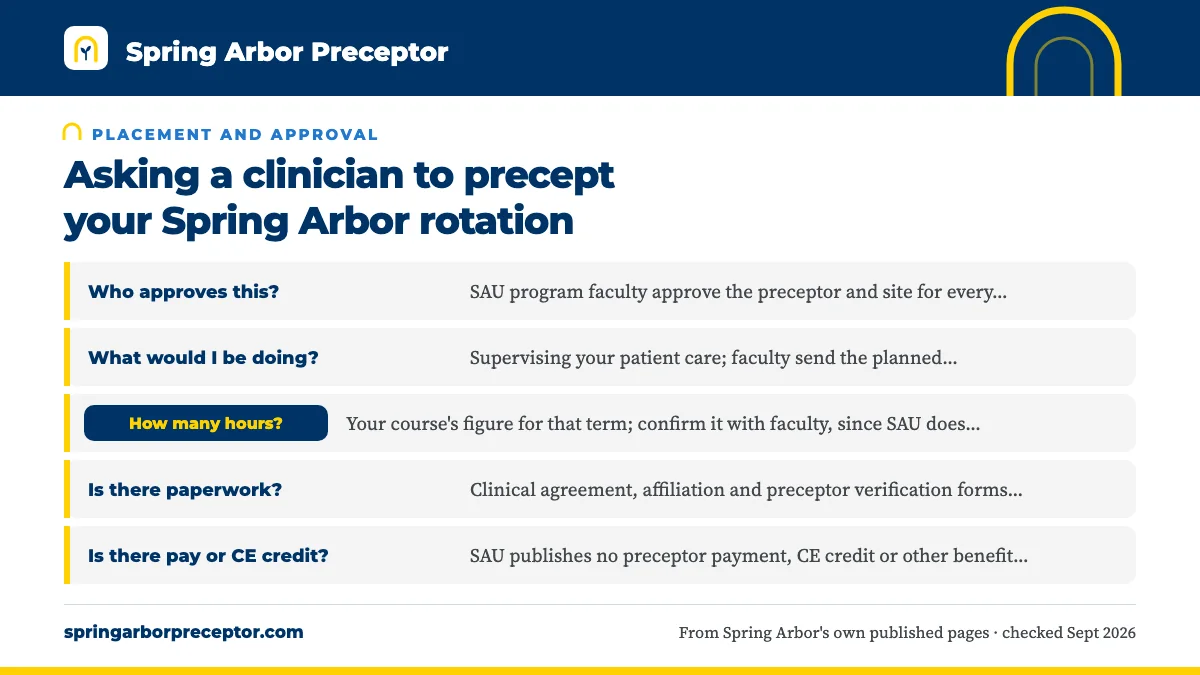
| They ask | What you can say |
|---|---|
| Who approves this? | SAU program faculty approve the preceptor and site for every rotation |
| What would I be doing? | Supervising your patient care; faculty send the planned progression and objectives for each rotation and keep in regular contact |
| How many hours? | Your course's figure for that term; confirm it with faculty, since SAU does not publish per-semester splits |
| Is there paperwork? | Clinical agreement, affiliation and preceptor verification forms, due at least four weeks before the course (2023-24 catalog) |
| Is there pay or CE credit? | SAU publishes no preceptor payment, CE credit or other benefit, so don't promise one |
| Will SAU visit? | SAU has not published whether faculty make site visits; ask your faculty before you answer |
Clinicians who want more detail can read precepting Spring Arbor students.
05Following up without wearing out the welcome
Silence isn't a no. Clinicians are busy, and a message can sink under a full inbox. One polite follow-up after about a week is reasonable; after two unanswered messages, move on and leave the door open.
Keep a simple log: name, practice, date asked, reply and next step. When you get a yes, send thanks the same day, confirm what happens next, and say when SAU's forms will arrive. Then settle the site's agreement question, because a clinician's yes still needs the organization behind it; clinical paperwork covers what comes next.
If the answer is no, ask whether they know anyone who might say yes. A name passed along by a colleague usually lands better than a message from a stranger.
06The first day, and why students hand us the outreach
Once faculty approve the rotation, SAU's clinicals post suggests emailing your preceptor beforehand to confirm location, time and dress, and doing any assigned reading. A short note confirming your dates and the hours you are aiming for that term sets a good tone from the start.
During the rotation, keep the preceptor's load light on your side: arrive prepared, log hours the same day, and flag any scheduling change well ahead. A preceptor who finds the arrangement easy is more likely to say yes to your next semester, or to a classmate after you.
If outreach is eating the time you need for coursework, our placement desk takes on the search and the first contact, using the same honest pitch: SAU's faculty approve every placement, and we bring the clinician everything they need to say yes with confidence. When your own leads have dried up, can't find a preceptor lays out the options, and how it works explains what we do and when.
Questions Spring Arbor students ask
Should I phone or email a prospective preceptor?
Either can work; what matters is that the request is short and specific. An email lets a busy clinician read it between patients and reply when they can, while a call or visit suits a practice you already know. A warm introduction from someone the clinician trusts often beats both.
What should I send a preceptor after they agree?
Confirm your dates and hours in writing, say when SAU's forms will reach them, and share SAU's credential rule for your track. SAU's faculty send the planned clinical progression and the rotation objectives after approval, so you don't need to write those yourself.
Can I offer to pay a preceptor?
SAU publishes nothing about paid preceptors or preceptor fees, either allowing or forbidding them. Ask your program before you raise money with any clinician, because faculty approve every preceptor and may hold a view that SAU hasn't put in writing. Get that answer by SAU email so it is on record.
Does Spring Arbor give preceptors continuing education credit?
SAU has not said so. Its clinicals post notes that many nursing schools offer CE or recertification credit, but that describes schools in general, not an SAU commitment. Don't promise CE, pay, library access or a title unless your program confirms it in writing.
How many clinicians should I contact at once?
Enough that one no doesn't stall you. SAU publishes no guidance on this, but working several leads at a time is safer than waiting on each reply before sending the next. Be straight with everyone: if two say yes, thank the one you don't need and ask whether you may come back to them for a later semester.
Related pages
Last checked 2026-09-24
We check these pages against Spring Arbor's own published sources. SAU's nursing faculty and current catalog have the final word.
More preceptor leads, sooner, for your SAU clinicals.
Tell us your Spring Arbor track, where you live and when your clinical course starts. We look for a preceptor and site that fit SAU's rules for your track and help you get the paperwork in on time.
- Matched to your track: FNP, AGPCNP, PMHNP, PNP, Nurse Educator or DNP
- Clinical agreement, affiliation and preceptor verification forms ready early
- In your home state, near where you live
Start your placement plan
A placement advisor replies with what an SAU-ready preceptor and site look like for you.