Spring Arbor RN-to-MSN: when clinicals come and what changes by track
Spring Arbor's six RN-to-MSN bridges take ADN and diploma nurses to the MSN in about four years, with the campus residency in year three and graduate clinical hours after it. Hours match the BSN-entry version of each track, from 125 to 625, apart from one educator figure SAU's own pages disagree on. That long runway is an advantage if you use it.
Plan ahead for your bridge clinicals
Tell us your track and expected practicum year, and a placement advisor will suggest when to start reaching out.
01Six bridges, six clinical loads
Every bridge page describes a four-year program for nurses with an ADN or diploma, with a 3.0 GPA over the last 60 credits and a current license required for admission, and one four-day campus residency during the third year. The AGPCNP, PNP, Nurse Educator and MSN/MBA bridges each list four intakes a year.
Credits and hours differ by track. Clinical course numbers below are the 2023-24 catalog's; your Brightspace list may show newer ones.
| Track | Credits | Clinical hours | Clinical course (2023-24) | Partner line in 2026? |
|---|---|---|---|---|
| FNP | 87 | 625 | NUR 680, three semesters | Yes |
| PMHNP | 82 | 500 | NUR 780M, two semesters | Yes |
| PNP-PC | 82 | 500 | NUR 780K, two semesters | No |
| AGPCNP | 82 | 500 | NUR 680, three semesters | No |
| Nurse Educator | 71 on the program page; 38 on the tuition page | 225 on the program page; 125 on the tuition page | NUR 780B and NUR 660 | No |
| MSN/MBA | 95 | 125 | NUR 780B | No |
02How the bridge reaches its first clinical day
In the 2023-24 catalog, two bridge courses, NUR 510 and NUR 522, count toward both the BSN and the MSN, and you need a 3.0 GPA at the end of the BSN portion to move on. From there you join the same graduate foundation as BSN-entry students.
The practicum gates are identical for both entry routes: NUR 612, NUR 618, NUR 602 and the residency NUR 602R must be passed first. Because RN-entry pages place the residency in year three, your graduate clinical hours start after it, in the back half of a four-year plan. Track-specific courses add to that, such as NUR 702 before the PNP practicum and NUR 714 before the PMHNP one.
The residency itself is covered on the MSN residency page, and the clinical prerequisites page sets out the full course order.
03The educator conflict: 225 or 125 hours
SAU's RN-to-MSN Nurse Educator page lists 71 credits and 225 clinical hours. SAU's tuition page lists 38 credits and 125 hours for the same program, which are exactly the BSN-entry figures and may have been copied across. Treat neither as settled until your advisor confirms yours.
There is older history too. An SAU blog post from around 2020 said RN-MSN students completed 200 clinical hours and named only three concentrations. Today there are six bridges. If you are on the educator bridge, ask your advisor to confirm your required hours in writing before you recruit anyone, then read the Nurse Educator page for how the practicum and internship split.
04Which bridges carry SAU's 2026 support line
The RN-to-FNP and RN-to-PMHNP pages now promise that SAU works with you on placements suited to where you want to train, backed by a clinical partner network. The RN-to-AGPCNP, RN-to-PNP, RN-to-Nurse Educator and RN-to-MSN/MBA pages carry no such line. No page names partners, and SAU's FAQ still tells every student to choose their own preceptor in their home state.
SAU's longest-running advice was written with bridge students in mind. Its 2015 post on finding a preceptor, still live, tells RN-MSN and NP students they can secure their own clinical preceptor in their hometown and should start in the first few months of the program. It also points students to the SAU Online program director for a list of nearby volunteer hosts. The partner network page explains what the newer wording does and doesn't cover.
05Using a four-year runway well
Starting early does not mean booking a preceptor three years out; a clinician's schedule that far ahead is hard to pin down. It means knowing, by your second year, which practices near you take students, which already hold affiliation agreements with SAU, and who in your own network might say yes when asked.
Use the time for the slow parts. Keep a short list of possible sites, note any that turned students away, and ask your Student Success Coach where SAU's volunteer-provider list stands in your area. About a year before your practicum, start real conversations; a semester or two before, get firm commitments and begin the paperwork. The clinical timeline page lays out lead times by semester.
Compliance checks repeat yearly under the 2023-24 catalog, so time the first background check and drug test for your practicum rather than your first semester, and ask your advisor when SAU wants them on file.
06State limits over a longer program
A four-year program raises the odds of a move, a new job or a new license. Four states remain outside SAU's nursing authorization (Alabama, Arizona, Louisiana and New York), and the March 2026 disclosure adds that the FNP, AGNP and PMHNP fall short of licensure requirements there. SAU's list doesn't address DC or the territories.
Washington is open for practice experiences to residents only. SAU's footnote covers its MSN programs, while the state board's June 2026 list names the FNP, AGPCNP, Nurse Educator, PNP-PC and PMHNP tracks but not the MSN/MBA, so bridge students on that track should confirm first.
Wherever you end up, the clinical state is the one your RN license must be unrestricted in. If you expect to relocate before your practicum, tell your advisor and check the state authorization page before you commit to the move.
07Why SAU's RN-to-MSN students choose us
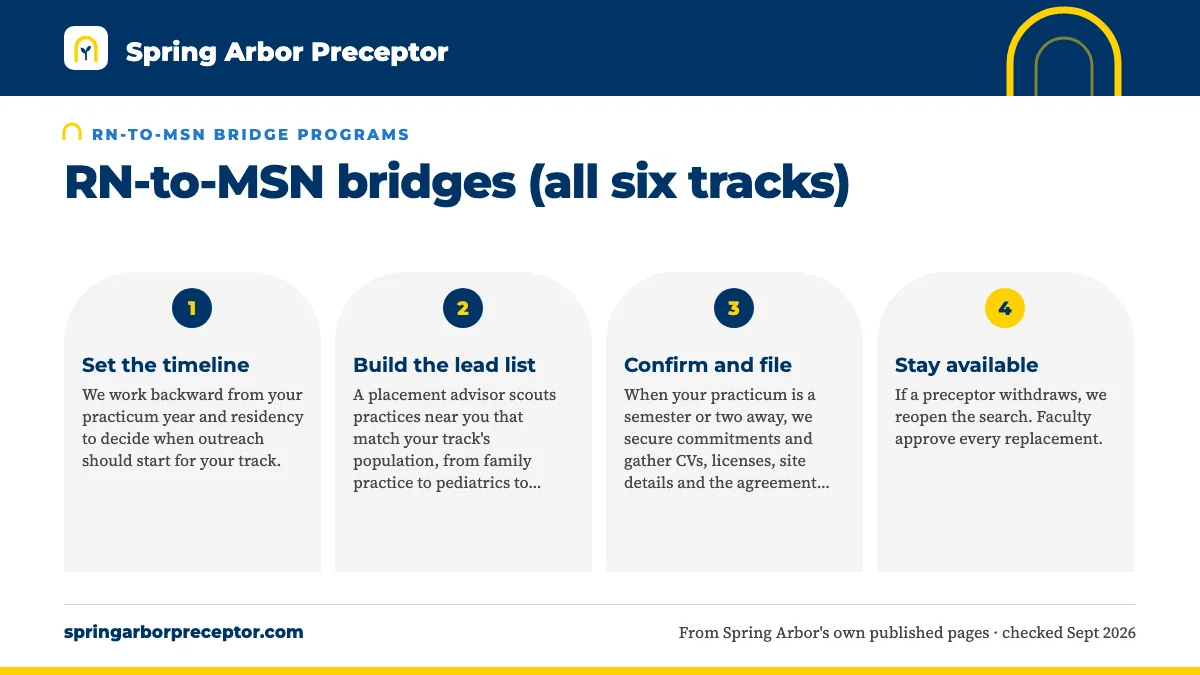
- Set the timelineWe work backward from your practicum year and residency to decide when outreach should start for your track.
- Build the lead listA placement advisor scouts practices near you that match your track's population, from family practice to pediatrics to psych, and notes which have hosted SAU students.
- Confirm and fileWhen your practicum is a semester or two away, we secure commitments and gather CVs, licenses, site details and the agreement and verification paperwork.
- Stay availableIf a preceptor withdraws, we reopen the search. Faculty approve every replacement.
SAU's faculty decide on every preceptor, and ours reach them screened and documented. A year or more before your practicum is a sensible time to talk to us about timing, even if the search itself starts later. Share your track through the form below and we'll suggest when to begin.
Questions Spring Arbor students ask
When do Spring Arbor RN-to-MSN students start clinicals?
After the residency and the other practicum prerequisites. RN-entry pages put the four-day residency in year three, and the 2023-24 catalog requires NUR 612, NUR 618, NUR 602 and NUR 602R before any practicum. Your advisor can place the exact semester on your plan of study.
Do RN-to-MSN students need more clinical hours than BSN-entry students?
Not on SAU's current pages. The RN-to-FNP lists 625, the PMHNP, PNP and AGPCNP bridges 500 each, and the MSN/MBA bridge 125, the same as the BSN-entry versions. The educator bridge is the exception, with 225 on its page and 125 on the tuition page.
Should I look for a preceptor during the BSN part of the bridge?
Start scouting, not booking. SAU advises starting within your first few months, but a firm commitment years ahead is rarely realistic. Build a list of practices and contacts early, then ask for dates about a year before your practicum and file paperwork once they agree.
What GPA do I need to move from the BSN phase into the MSN?
The 2023-24 catalog required a 3.0 GPA at the end of the BSN portion to continue into the MSN. Admission to the bridge also asks for a 3.0 over your last 60 credits. Check the current requirement with your advisor, since the catalog is from 2023-24.
Does the RN-to-MSN include a campus visit?
Yes, one. Every bridge page lists a single four-day campus residency during the third year, held on the main campus in Spring Arbor, Michigan and tied to advanced health assessment. It has to be passed before your graduate practicum can start.
Related pages
Last checked 2026-09-24
We check these pages against Spring Arbor's own published sources. SAU's nursing faculty and current catalog have the final word.
More preceptor leads, sooner, for your SAU clinicals.
Tell us your Spring Arbor track, where you live and when your clinical course starts. We look for a preceptor and site that fit SAU's rules for your track and help you get the paperwork in on time.
- Matched to your track: FNP, AGPCNP, PMHNP, PNP, Nurse Educator or DNP
- Clinical agreement, affiliation and preceptor verification forms ready early
- In your home state, near where you live
Start your placement plan
A placement advisor replies with what an SAU-ready preceptor and site look like for you.