Transferring clinical hours into a Spring Arbor certificate
Under the 2023-24 Graduate Catalog, a post-master's certificate student may bring in at most 125 earlier clinical hours, except an adult-gerontology NP moving to FNP, who may count up to 375 primary care hours. Nurse Educator certificate hours do not transfer at all. SAU's live pages show the effect as a range for the FNP certificate only: 250 to 625 hours.
Get your placement plan
Tell us your Spring Arbor track and where you live. A placement advisor replies with what your preceptor and site need to look like for Spring Arbor to approve them.
01The transfer rules, certificate by certificate
The 2023-24 catalog's certificate rules set a floor somewhere from 250 to 625 direct-care hours, varying by track, along with the transfer limits below. Course codes and credits come from that catalog too. Later catalogs cannot be read publicly, so confirm the current rule with admissions or your advisor and check the course list in Brightspace once enrolled.
| Certificate | Hours (live page) | Clinical course (2023-24) | Transfer (2023-24) |
|---|---|---|---|
| FNP | 250 to 625 | NUR 680N, three semesters, 10 credits | Up to 125; up to 375 primary care hours from an AGNP |
| AGPCNP | 500 | NUR 680G, two semesters, 8 credits | Up to 125 |
| PMHNP | 500 | NUR 780M, two semesters, 8 credits | Up to 125 |
| PNP-PC | 500 | NUR 780K, two semesters, 8 credits | Up to 125 |
| Nurse Educator | 150 internship hours | NUR 660 | None |
02Reading the FNP range
SAU's live PMC-FNP page gives 250 to 625 clinical hours and ties the figure to the certification you already hold. When SAU launched its certificates in 2020, the FNP came in two versions, one for nurses who were already NPs and one for nurses who were not. The live page's range reflects that split.
The published numbers fit together. The full FNP track is 625 hours, and 625 less the 375-hour AGNP allowance is 250, the bottom of the range. SAU does not set out that arithmetic itself, so treat it as a reading of the figures and get your own number in writing.
A nurse without NP certification should expect to sit at or near the top of the range. For other NPs moving to FNP, the 2023-24 wording allows up to 125 hours, but SAU does not say which earlier hours qualify. The PMC-FNP page and the NUR 680 page cover the practicum itself.
03Certificates listed at a flat 500
The live AGPCNP, PMHNP and PNP-PC certificate pages each list 500 clinical hours and say nothing about transfer. The 2023-24 catalog, meanwhile, allowed up to 125 earlier hours for every certificate except the Nurse Educator. Both can be true, but you should not assume a reduction until SAU confirms one for you.
Fit matters too. An FNP adding the PMHNP brings primary care hours, not psychiatric ones, and SAU does not say whether hours from a different population count at all. The same question applies to an FNP moving into pediatric primary care.
Credit ranges on the tuition page hint at how individual these plans are: 21 to 30 credits for the AGPCNP and 24 to 33 for the PMHNP and PNP-PC, and SAU notes that certificate start dates depend on prerequisites. For the practicums themselves, read NUR 780M or NUR 780K.
04Where nothing transfers: the Nurse Educator certificate
The 2023-24 catalog is plain on this one: the Nurse Educator certificate calls for 150 hours in total (a 50/100 split between direct care and an academic setting) and allows no transfer. The live certificate page still lists 150 internship hours.
Teaching experience, a prior practicum or years of precepting do not reduce that figure under the published rule. What changes is how easily you can find a site. The same live page also lists NUR 780B, the 125-hour direct-care practicum, without explaining how it relates to the 150 internship hours. Ask the program before you plan, and if you are told NUR 780B applies to you, budget a direct-care preceptor as well as an education setting. The internship is covered on the NUR 660 page.
05What to gather before you enroll
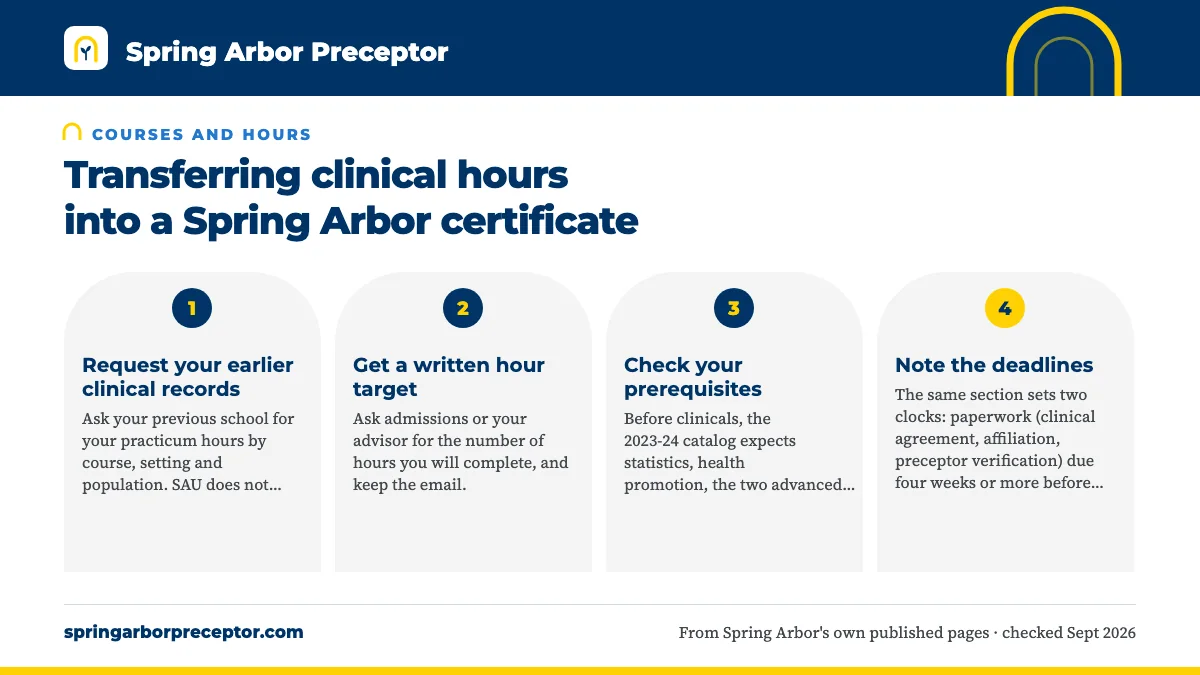
- Request your earlier clinical recordsAsk your previous school for your practicum hours by course, setting and population. SAU does not publish what proof it accepts, so ask admissions which form it wants.
- Get a written hour targetAsk admissions or your advisor for the number of hours you will complete, and keep the email.
- Check your prerequisitesBefore clinicals, the 2023-24 catalog expects statistics, health promotion, the two advanced science courses (
NUR 612,NUR 618) and health assessment with its residency (NUR 602,NUR 602R), or a head-to-toe video inNUR 610if you were excused from the residency. See the prerequisites page. - Note the deadlinesThe same section sets two clocks: paperwork (clinical agreement, affiliation, preceptor verification) due four weeks or more before each clinical course, and three years to finish the certificate.
06Planning the hours that remain
Once you know your number, the preceptor search can be sized to it. A certificate student needing 250 hours may manage with one preceptor; one needing 625 across three semesters will likely need a plan for more. The PMC-FNP and PMC-PMHNP pages carry SAU's 2026 line about a clinical partner network; the other three certificate pages do not.
A placement advisor searches for preceptors near you who fit the new population you are adding, and pulls together what faculty will check. Every preceptor, including one who supervised you in an earlier program, still needs SAU faculty approval. The certificates overview compares all five, and you can send us your certificate and target hours to start.
Questions Spring Arbor students ask
How many clinical hours will I need for the Spring Arbor PMC-FNP?
Somewhere from 250 to 625, depending on the certification you hold. Under the 2023-24 catalog an adult-gerontology NP can bring in as many as 375 primary care hours, and other certificate students up to 125. SAU does not publish individual figures, so ask admissions for your target in writing before you enroll.
Will my primary care NP hours reduce the PMHNP certificate's 500?
Possibly, but do not count on it. The 2023-24 catalog allowed up to 125 earlier hours for most certificates, yet the live PMC-PMHNP page lists 500 with no mention of transfer, and SAU does not say whether primary care hours can count toward psychiatric ones. Ask admissions before you plan preceptors.
Is there a time limit on finishing a Spring Arbor certificate?
Yes: under the 2023-24 catalog you have three years to finish. SAU's live pages suggest most students finish sooner, with estimates between 14 and 24 months depending on the certificate. Transferred hours can shorten the clinical part, so ask admissions which estimate fits your own plan.
Is a preceptor from my earlier program already approved?
No. SAU approves preceptors and sites one rotation at a time, so someone who supervised you elsewhere still goes through SAU's review and paperwork. Having worked together can make the request easier to make, but it does not replace the forms or the four-week lead time.
Does the tuition page's credit range tell me my hours?
Not directly. The ranges (for example 23 to 32 credits for the FNP certificate) reflect coursework you may or may not need, and SAU says start dates vary with your prerequisites. Hours and credits are related but separate questions, so ask admissions for both figures when you apply.
Related pages
Last checked 2026-09-24
We check these pages against Spring Arbor's own published sources. SAU's nursing faculty and current catalog have the final word.
More preceptor leads, sooner, for your SAU clinicals.
Tell us your Spring Arbor track, where you live and when your clinical course starts. We look for a preceptor and site that fit SAU's rules for your track and help you get the paperwork in on time.
- Matched to your track: FNP, AGPCNP, PMHNP, PNP, Nurse Educator or DNP
- Clinical agreement, affiliation and preceptor verification forms ready early
- In your home state, near where you live
Start your placement plan
A placement advisor replies with what an SAU-ready preceptor and site look like for you.