Spring Arbor post-master's FNP: 250 to 625 hours, depending on where you start
Spring Arbor's online post-master's FNP certificate asks for between 250 and 625 clinical hours, depending on your earlier certification, taken in the 2023-24 catalog as NUR 680N over three semesters. A certified AGNP moving to family practice has the shortest path. For an NP adding family practice, the new ground is usually children and the childbearing family, and the preceptor search should aim there.
Scope your PMC-FNP hours
Tell us your current certification and where you practice, and a placement advisor will aim the search at the hours you still need.
01Why the hour range is so wide
The live certificate FNP page lists 250 to 625 clinical hours and 18 to 24 months to finish, and the tuition page gives 23 to 32 credits. SAU ties the hour range to your prior certification, and the 2023-24 catalog shows the mechanism: some earlier clinical hours can transfer. When the certificates launched in 2020, SAU described two FNP routes, one for nurses who are already NPs and one for master's-prepared nurses who are not.
The 2023-24 catalog set the transfer rules. No more than 125 earlier hours could count, except for AGNP-to-FNP students, who could bring up to 375 primary care hours. The table applies that arithmetic; it is our reading, not an SAU chart, so get your own figure from admissions in writing.
| Starting point | Transfer cap (2023-24) | Hours left if the full cap is accepted |
|---|---|---|
| Certified AGNP | Up to 375 primary care hours | 250 |
| Other certified NP | Up to 125 hours | 500 |
| Master's-prepared, not an NP | Up to 125, if eligible hours exist | 500 to 625; ask admissions |
The hour transfer page covers which earlier hours may qualify and what to have ready when you ask.
02The courses and NUR 680N
In the 2023-24 catalog the FNP certificate opened with NUR 610 Foundation of Post-Graduate Nursing, then drew on four MSN family courses: adult care in NUR 685, older adults in NUR 686, the childbearing family in NUR 645 and children in NUR 687. The clinical course was NUR 680N, three semesters and 10 credits in all, and the certificate totaled 23 credits.
The MSN track's practicum is NUR 680; the certificate version carried its own number. Newer catalogs couldn't be read, so rely on your Brightspace course list or your advisor for current numbers. One more caution: the live certificate FNP page pairs NUR 687 with a description copied from a PMHNP course, so don't send that page to a preceptor as your outline. The NUR 680 practicum page covers both versions.
03Filling the pediatric and family gap
For an AGNP, adults and older adults are familiar. What NUR 645 and NUR 687 add is prenatal and childbearing care and primary care of children, and your remaining hours should show that. No SAU page sets a pediatric or women's health quota for the FNP, so ask faculty early how they expect the certificate hours to be weighted.
Preceptors follow the NP practicum rule in the 2023-24 catalog: a certified NP, physician or PA, local to you and approved by program faculty for each rotation. Good targets are family practices with steady well-child and prenatal visits, pediatric offices and community health clinics that see whole families. A preceptor who mirrors your current adult practice adds less to what you already know.
04Paperwork, prerequisites and timing
The four-week rule lives in the certificate section of the 2023-24 catalog, which wants the clinical agreement, affiliation and preceptor verification forms in hand no later than four weeks before a clinical course begins. The same section gives three years to finish. SAU hasn't published the current form titles; your program will supply them, and you can see the clinical paperwork page for what to collect.
Before clinicals, the 2023-24 catalog expected the core graduate courses (health assessment with its residency, pathophysiology and pharmacology), a health promotion course and statistics, taken at SAU or matched from your earlier master's. A student excused from the assessment course and residency could instead film a complete head-to-toe assessment for NUR 610. Start dates vary with what you bring, so your first term depends on SAU's review of your transcript.
05SAU's 2026 support line on the certificate FNP page
An archive copy of the certificate FNP page from July 16, 2026 lacks the newer placement wording. By September 2026 the live page had it: a promise to help you secure placements near where you want to train, along with a clinical partner network. It is one of six NP pages carrying that line.
No partners are named and no page describes how certificate students reach the network. SAU's FAQ has not changed: it still has you choosing your own preceptor in your home state, and no page promises a site. Ask the NP program leadership what the network can offer for pediatric and family rotations near you, and keep your own list going; as a working NP, your own colleagues in family practice are worth asking first. The partner network page has the full picture.
06State notes, including Washington
The FNP certificate isn't an option for clinicals in Alabama, Arizona, Louisiana or New York, where SAU's nursing programs lack authorization and, per the March 2026 disclosure, the FNP misses licensure requirements. Wherever your certificate hours happen, your RN license there has to be current and unrestricted. If you practice in one state and live in another, confirm with faculty which state the certificate rotations should sit in.
Washington is the tricky one. SAU's footnote says its Washington approval for residents covers the FNP certificate. The Washington board's November 2025 and June 2026 lists of approved out-of-state placements include SAU's MSN FNP and its PMHNP certificate but not the FNP certificate. If you live in Washington, get written confirmation from SAU before you recruit a preceptor there, and read the state authorization page.
07Why post-master's FNP students choose us
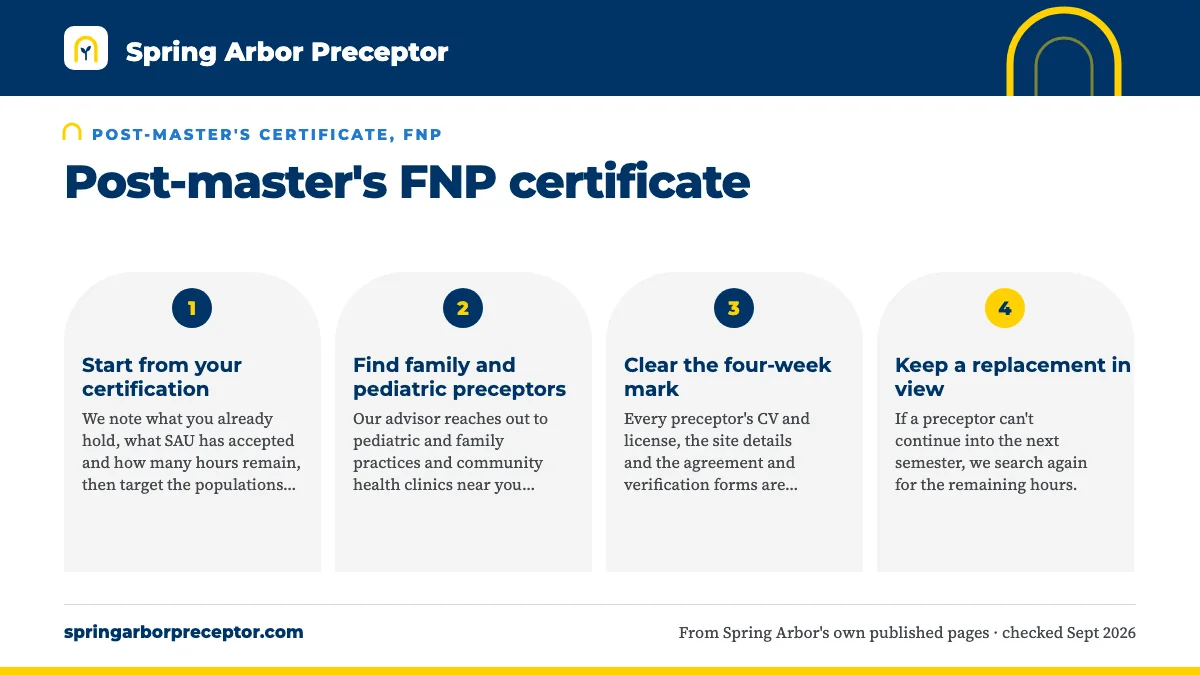
- Start from your certificationWe note what you already hold, what SAU has accepted and how many hours remain, then target the populations the certificate adds.
- Find family and pediatric preceptorsOur advisor reaches out to pediatric and family practices and community health clinics near you, looking for NPs, physicians or PAs with room for a student.
- Clear the four-week markEvery preceptor's CV and license, the site details and the agreement and verification forms are assembled with the four-week deadline as the target.
- Keep a replacement in viewIf a preceptor can't continue into the next semester, we search again for the remaining hours.
Approval of each certificate preceptor and site rests with program faculty, and every one we bring is matched to the populations the certificate adds. If a colleague has already agreed to precept, we take on the paperwork alone. Tell us your certification through the form below to begin.
Questions Spring Arbor students ask
How many hours will I need for Spring Arbor's post-master's FNP?
Somewhere between 250 and 625, according to the live certificate page. Where you land depends on your prior NP certification and how many earlier hours SAU accepts. Under the 2023-24 catalog, an AGNP could transfer up to 375 primary care hours and most others up to 125. Admissions confirms your number.
I'm an AGNP. Which of my hours can transfer?
The 2023-24 catalog allowed AGNP-to-FNP students to transfer up to 375 primary care hours, the one exception to the usual 125-hour cap. That would leave 250 hours, the low end of SAU's range. Current rules may differ, so ask admissions to confirm your accepted hours in writing.
Is NUR 680N the same course as NUR 680?
They serve the same purpose. In the 2023-24 catalog the MSN FNP takes NUR 680 at 2, 4 and 4 credits, while the certificate takes NUR 680N over three semesters totaling 10 credits. Numbers may have changed since, so check Brightspace.
Can I do certificate hours at the practice where I already work as an NP?
SAU doesn't publish a rule on precepting at your own employer. The bigger issue is scope: hours should cover the children and families the certificate adds, which your current adult practice may not see. Ask faculty first, and see our employer clinical site page.
Can I complete the post-master's FNP in Washington?
SAU's footnote says yes for Washington residents, but the state board's June 2026 list includes only SAU's PMHNP certificate among its certificates. Until those sources agree, ask SAU for written confirmation before arranging any FNP certificate hours in Washington. Keep that confirmation with your records.
Related pages
Last checked 2026-09-24
We check these pages against Spring Arbor's own published sources. SAU's nursing faculty and current catalog have the final word.
More preceptor leads, sooner, for your SAU clinicals.
Tell us your Spring Arbor track, where you live and when your clinical course starts. We look for a preceptor and site that fit SAU's rules for your track and help you get the paperwork in on time.
- Matched to your track: FNP, AGPCNP, PMHNP, PNP, Nurse Educator or DNP
- Clinical agreement, affiliation and preceptor verification forms ready early
- In your home state, near where you live
Start your placement plan
A placement advisor replies with what an SAU-ready preceptor and site look like for you.