Short on time before an SAU clinical course
If your practicum is weeks away and you have no approved preceptor, your real deadline is earlier than the course start. The 2023-24 catalog wants the clinical agreement, affiliation and preceptor verification forms in at least four weeks ahead. Count back from that date, tell SAU where you stand now, and spend your effort where speed is realistic.
Get your placement plan
Tell us your Spring Arbor track and where you live. A placement advisor replies with what your preceptor and site need to look like for Spring Arbor to approve them.
01Count back from the four-week mark
Start with the date your practicum course begins and subtract four weeks. That is the latest point the 2023-24 catalog allows for your paperwork. Subtract again for the time a practice needs to sign and return its part, and you have the date by which you need a firm yes from a preceptor.
SAU runs one seven-week course at a time, with clinical courses alongside, inside two long semesters a year: fall from July and spring from January. Your advisor can confirm the exact start of your practicum, and the clinical timeline page shows how those pieces fit together across a program.
02Tell SAU where you stand, today
Don't wait until you have a name to contact faculty. Email your clinical faculty or program director, copy your Student Success Coach, and say plainly when your practicum starts, where your search stands and which leads are in progress.
Ask what happens if the forms cannot be in four weeks ahead. SAU does not publish an exception process, so only faculty can tell you whether one exists for your situation. Raising it early keeps your options open; raising it the week the course opens usually closes them.
If you are an FNP or PMHNP student, ask in the same message what the clinical partner network named on SAU's 2026 pages can offer for your state and dates.
03Clear everything that isn't the preceptor
A preceptor is rarely the only thing between you and a start date. Work on these at the same time as the search, because each can hold up approval on its own.
- Prerequisites: the 2023-24 catalog lists
NUR 612,NUR 618,NUR 602and theNUR 602Rresidency before a practicum. Check your current course list in Brightspace. - Compliance: background check, drug test, immunizations, TB testing, CPR/BLS, HIPAA training and liability insurance, all current.
- License: an unrestricted RN license in the state where you will practice.
- Permission to begin clinicals, which the catalog ties to academic standing, completed prerequisites and approval from your advisor and the nursing department.
The full list, and how often each item repeats, is on the clinical compliance page.
04Where speed realistically comes from
On a short clock, favor leads that remove steps. A site that already holds an affiliation agreement with SAU skips the slowest stage. A preceptor who has hosted SAU students knows the faculty contact and the objectives. Both are worth asking SAU about by name.
Your own workplace can be quick for the same reasons, though SAU publishes nothing specific about it, so ask faculty first. Leads that add steps, such as a large health system that would need a brand-new contract with SAU, are worth pursuing only alongside faster options. Affiliation agreements explains why that stage drags.
Be honest with each practice about your timeline. A clinician who knows the paperwork has to reach SAU within days can tell you straight away whether their office can manage it, which saves you waiting on a slow no.
05What we do when time is short
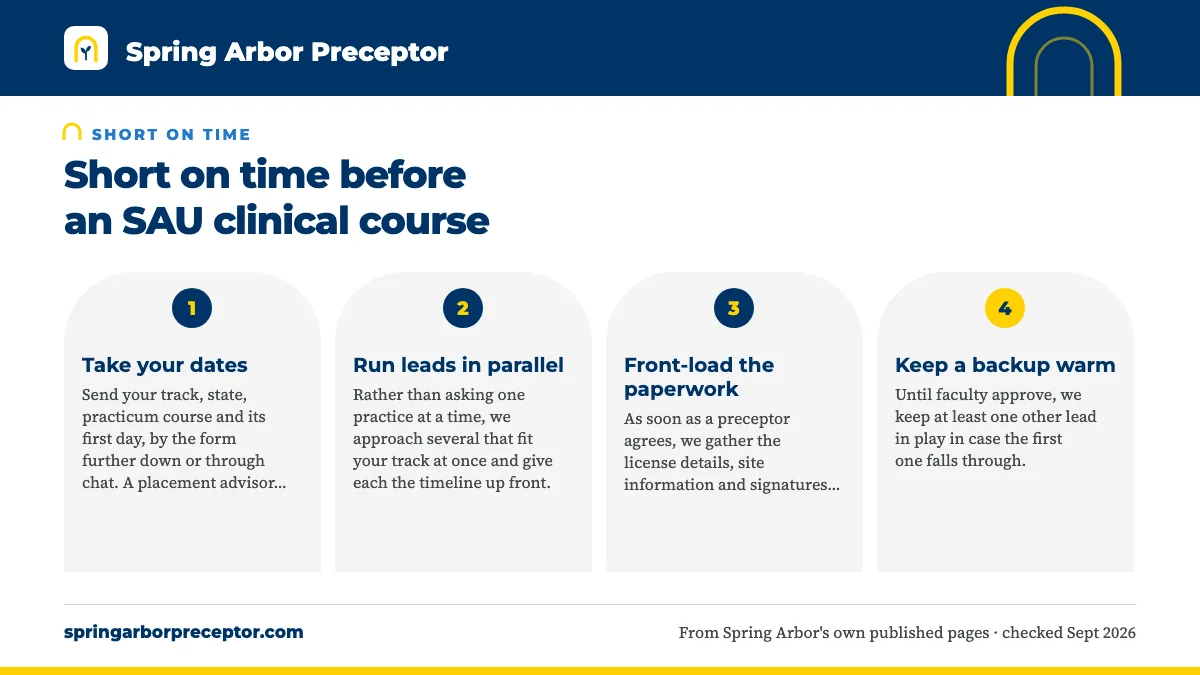
- Take your datesSend your track, state, practicum course and its first day, by the form further down or through chat. A placement advisor works back from the four-week mark with you.
- Run leads in parallelRather than asking one practice at a time, we approach several that fit your track at once and give each the timeline up front.
- Front-load the paperworkAs soon as a preceptor agrees, we gather the license details, site information and signatures the practice must supply, so you can submit without waiting on them.
- Keep a backup warmUntil faculty approve, we keep at least one other lead in play in case the first one falls through.
Faculty set the pace of approval. Our side runs at full speed: several leads at once, paperwork gathered as soon as a preceptor agrees, and a backup kept warm.
06If it cannot be done in time
Sometimes the honest answer is that this semester's start is out of reach. That is a conversation for your advisor and clinical faculty, who can tell you how your plan would shift and what the next realistic start looks like. It is far better to have it early than after the course has opened, when fewer choices remain.
If that happens, use the extra time well: lock in a preceptor for the next start, clear compliance, and keep a second lead. Delayed graduation explains what a missed start can mean in time, and how to protect the next one.
Questions Spring Arbor students ask
Is the four-week rule still in force?
The four-week lead time comes from the 2023-24 Graduate Catalog, in its post-master's certificate section. The current catalogs sit behind a verification check and could not be read, so ask your faculty or check your practicum course in Brightspace for the deadline that applies to you this semester.
Can I start the course and add a preceptor later?
SAU publishes nothing that allows it, and faculty approve every preceptor and site for each rotation. Don't plan on it. Ask your clinical faculty directly what happens if your paperwork is not complete when the course opens, and get the answer before registration closes.
Is SAU's clinical partner network faster?
Nothing SAU publishes says how quickly the partner network works, which states it covers or who is in it. FNP and PMHNP students should raise it the same day they raise the deadline with faculty, and pursue it alongside other leads rather than waiting on it alone.
Can you get a preceptor approved faster?
Approval and its timing belong to SAU's program faculty. What we speed up is everything before their review: finding a preceptor who fits your track, and getting the practice's share of the paperwork to you complete, so faculty are not left waiting on missing pieces.
What if my compliance isn't done yet?
Start it now, alongside the search. The 2023-24 catalog wants proof before any practicum, and a background check or immunization record can take time to come back. A willing preceptor does not help if your own file is incomplete when faculty review it.
Related pages
Last checked 2026-09-24
We check these pages against Spring Arbor's own published sources. SAU's nursing faculty and current catalog have the final word.
More preceptor leads, sooner, for your SAU clinicals.
Tell us your Spring Arbor track, where you live and when your clinical course starts. We look for a preceptor and site that fit SAU's rules for your track and help you get the paperwork in on time.
- Matched to your track: FNP, AGPCNP, PMHNP, PNP, Nurse Educator or DNP
- Clinical agreement, affiliation and preceptor verification forms ready early
- In your home state, near where you live
Start your placement plan
A placement advisor replies with what an SAU-ready preceptor and site look like for you.